Wednesday, August 1, 2018

Facebook and Instagram now show how many minutes you use them

It’s passive zombie feed scrolling, not active communication with friends that hurts our health, according to studies Facebook has been pointing to for the last seven months. Yet it’s treating all our social networking the same with today’s launch of its digital wellbeing screentime management dashboards for Facebook and Instagram in the US before rolling them out to everyone in the coming weks.

Giving users a raw count of the minutes you’ve spent in their apps each day in the last week plus your average across the week is a good start to making users more mindful. But by burying them largely out of sight, giving them no real way to compel less usage, and not distinguishing between passive and active behavior, they seem destined to be ignored while missing the point the company itself stresses.

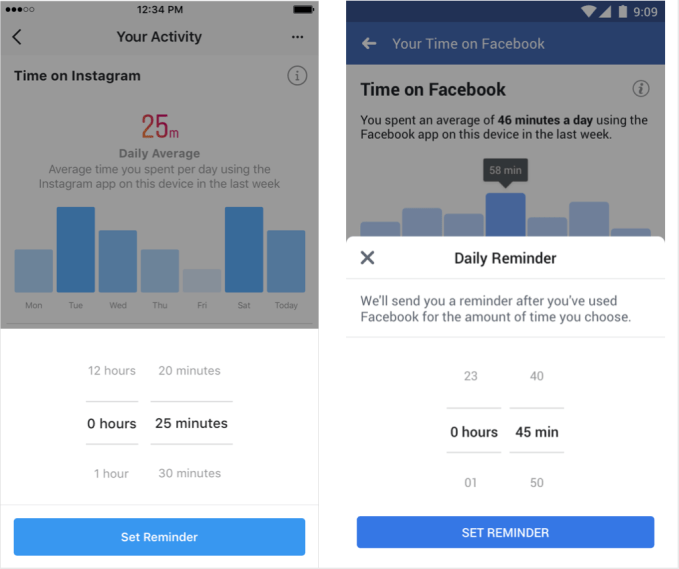
TechCrunch scooped the designs of the two separate but identical Instagram and Facebook tools over the past few months thanks to screenshots generated from the apps’ code by Jane Manchun Wong. What’s launching today is what we saw, with the dashboards located in Facebook’s “Settings” -> “Your Time On Facebook” and Instagram’s “Settings” -> “Your Activity”.

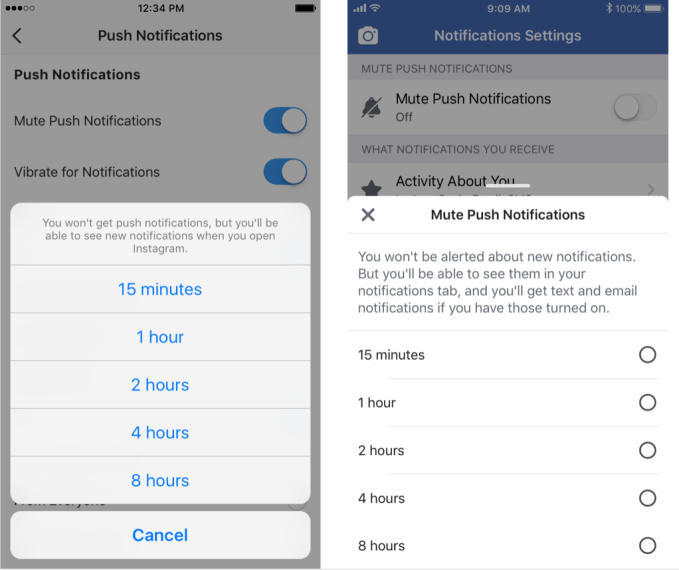
Beyond the daily and average minute counts, you can set a daily “limit” in minutes after which either app will send you a reminder that you’ve crossed your self-imposed threshold. But they won’t stop you from browsing and liking, or force you to dig into the settings menu to extend your limit. You’ll need the willpower to cut yourself off. The tools also let you mute push notifications (you’ll still see in-app alerts), but only for as much as 8 hours. If you want anything more permanent, you’ll have to dig into their separate push notification options menu or your phone’s settings.
The announcement follows Instagram CEO Kevin Systrom’s comments about our original scoop, where he tweeted “It’s true . . . We’re building tools that will help the IG community know more about the time they spend on Instagram – any time should be positive and intentional . . . Understanding how time online impacts people is important, and it’s the responsibility of all companies to be honest about this. We want to be part of the solution. I take that responsibility seriously.”

Users got their first taste of Instagram trying to curtai overuse with its “You’re All Caught Up” notices that show when you’ve seen all your feed posts from the past two days. Both apps will now provide callouts to users teaching them about the new activity monitoring tools. Facebook says it has no plans to use whether you open the tools or set daily limits to target ads. It will track how people use the tool to tweak the design, but it sounds like that’s more about what time increments to show in the Daily Reminder and Mute Notifications options than drastic strengthenings of their muscle.

“It’s really important for people who use Instagram and Facebook that the time they spend with us is time well spent” Ameet Ranadive, Instagram’s Product Director of Well-Being, told reporters on a conference call. “There may be some tradeoff with other metrics for the company and that’s a tradeoff we’re willing to live with, because in the longer term we think this is important to the community and we’re willing to invest in it.”

Facebook has already felt some of the brunt of the tradeoff. It’s been trying to improve digital wellbeing by showing fewer low quality viral videos and clickbait news stories, and more from your friends. That’s contributed to a flatlining of its growth in North America, and even a temporary drop of 700,000 users while it also lost 1 million users in Europe this past quarter. That led to Facebook’s slowest user growth rates in history, triggering a 20 percent, $120 billion market cap drop in its share price. “The changes to the News Feed back in January were one step . . . giving people a sense of their time so they’re more mindful of it is the second step” says Ranadive.
The fact that Facebook is willing to put its finances on the line for digital wellbeing is a great step. But it’s likely to be changes to the Facebook and Instagram feeds that prioritize content you’ll comment on rather than look at and silently scroll past that will contribute more to healthy social networking than today’s toothless tools.
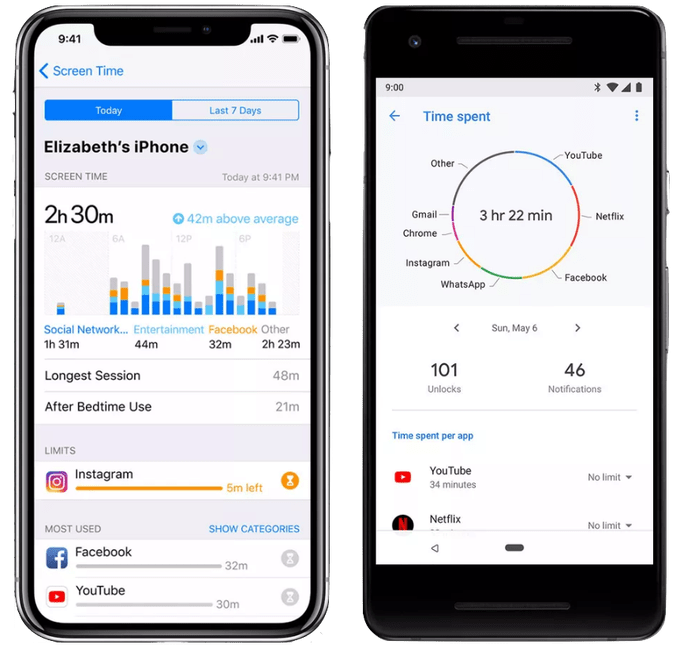
iOS Screen Time (left) and Android Digital Wellbeing (right)

While iOS 12’s Screen Time and Android’s new Digital Wellbeing features both count your minutes on different apps too, they offer more drastic ways to enforce your own good intentions. iOS will deliver a weekly usage report to remind you the features exist. Android’s is best-in-class because it grays out an app’s icon and requires you to open your settings to unlock an app after you exceed your daily limit.

To live up to the responsibility Systrom promised, Facebook and Instagram will have to do more to actually keep us mindful of the time we spend in their apps and help us help ourselves. Let us actually lock ourselves out of the apps, turn them grayscale, fade their app icons, or persistently show our minute count onscreen once we pass our limit. Anything to make being healthy on their apps something you can’t just ignore like any other push notification.

Or follow the research and have the dashboards actually divide our sharing, commenting, and messaging time from our feed scrolling, Stories tapping, video watching, and photo stalking. The whole point is that social networking isn’t all bad, but there are behaviors that hurt. Most of us aren’t going to give up Facebook and Instagram. Even just trying to spend less time on them is difficult. But by guiding us towards the activities that interconnect us rather than isolate us, Facebook could get us to shift our time in the right direction.

source https://techcrunch.com/2018/08/01/facebook-and-instagram-your-activity-time/


source https://derekpackard.com/facebook-and-instagram-now-show-how-many-minutes-you-use-them-3/

Facebook and Instagram now show how many minutes you use them

It’s passive zombie feed scrolling, not active communication with friends that hurts our health, according to studies Facebook has been pointing to for the last seven months. Yet it’s treating all our social networking the same with today’s launch of its digital wellbeing screentime management dashboards for Facebook and Instagram in the US before rolling them out to everyone in the coming weks.

Giving users a raw count of the minutes you’ve spent in their apps each day in the last week plus your average across the week is a good start to making users more mindful. But by burying them largely out of sight, giving them no real way to compel less usage, and not distinguishing between passive and active behavior, they seem destined to be ignored while missing the point the company itself stresses.

TechCrunch scooped the designs of the two separate but identical Instagram and Facebook tools over the past few months thanks to screenshots generated from the apps’ code by Jane Manchun Wong. What’s launching today is what we saw, with the dashboards located in Facebook’s “Settings” -> “Your Time On Facebook” and Instagram’s “Settings” -> “Your Activity”.

Beyond the daily and average minute counts, you can set a daily “limit” in minutes after which either app will send you a reminder that you’ve crossed your self-imposed threshold. But they won’t stop you from browsing and liking, or force you to dig into the settings menu to extend your limit. You’ll need the willpower to cut yourself off. The tools also let you mute push notifications (you’ll still see in-app alerts), but only for as much as 8 hours. If you want anything more permanent, you’ll have to dig into their separate push notification options menu or your phone’s settings.

The announcement follows Instagram CEO Kevin Systrom’s comments about our original scoop, where he tweeted “It’s true . . . We’re building tools that will help the IG community know more about the time they spend on Instagram – any time should be positive and intentional . . . Understanding how time online impacts people is important, and it’s the responsibility of all companies to be honest about this. We want to be part of the solution. I take that responsibility seriously.”

Users got their first taste of Instagram trying to curtai overuse with its “You’re All Caught Up” notices that show when you’ve seen all your feed posts from the past two days. Both apps will now provide callouts to users teaching them about the new activity monitoring tools. Facebook says it has no plans to use whether you open the tools or set daily limits to target ads. It will track how people use the tool to tweak the design, but it sounds like that’s more about what time increments to show in the Daily Reminder and Mute Notifications options than drastic strengthenings of their muscle.

“It’s really important for people who use Instagram and Facebook that the time they spend with us is time well spent” Ameet Ranadive, Instagram’s Product Director of Well-Being, told reporters on a conference call. “There may be some tradeoff with other metrics for the company and that’s a tradeoff we’re willing to live with, because in the longer term we think this is important to the community and we’re willing to invest in it.”

Facebook has already felt some of the brunt of the tradeoff. It’s been trying to improve digital wellbeing by showing fewer low quality viral videos and clickbait news stories, and more from your friends. That’s contributed to a flatlining of its growth in North America, and even a temporary drop of 700,000 users while it also lost 1 million users in Europe this past quarter. That led to Facebook’s slowest user growth rates in history, triggering a 20 percent, $120 billion market cap drop in its share price. “The changes to the News Feed back in January were one step . . . giving people a sense of their time so they’re more mindful of it is the second step” says Ranadive.

The fact that Facebook is willing to put its finances on the line for digital wellbeing is a great step. But it’s likely to be changes to the Facebook and Instagram feeds that prioritize content you’ll comment on rather than look at and silently scroll past that will contribute more to healthy social networking than today’s toothless tools.

iOS Screen Time (left) and Android Digital Wellbeing (right)

While iOS 12’s Screen Time and Android’s new Digital Wellbeing features both count your minutes on different apps too, they offer more drastic ways to enforce your own good intentions. iOS will deliver a weekly usage report to remind you the features exist. Android’s is best-in-class because it grays out an app’s icon and requires you to open your settings to unlock an app after you exceed your daily limit.

To live up to the responsibility Systrom promised, Facebook and Instagram will have to do more to actually keep us mindful of the time we spend in their apps and help us help ourselves. Let us actually lock ourselves out of the apps, turn them grayscale, fade their app icons, or persistently show our minute count onscreen once we pass our limit. Anything to make being healthy on their apps something you can’t just ignore like any other push notification.

Or follow the research and have the dashboards actually divide our sharing, commenting, and messaging time from our feed scrolling, Stories tapping, video watching, and photo stalking. The whole point is that social networking isn’t all bad, but there are behaviors that hurt. Most of us aren’t going to give up Facebook and Instagram. Even just trying to spend less time on them is difficult. But by guiding us towards the activities that interconnect us rather than isolate us, Facebook could get us to shift our time in the right direction.

source https://techcrunch.com/2018/08/01/facebook-and-instagram-your-activity-time/


source https://derekpackard.com/facebook-and-instagram-now-show-how-many-minutes-you-use-them-2/

Facebook and Instagram now show how many minutes you use them

It’s passive zombie feed scrolling, not active communication with friends that hurts our health, according to studies Facebook has been pointing to for the last seven months. Yet it’s treating all our social networking the same with today’s launch of its digital wellbeing screentime management dashboards for Facebook and Instagram in the US before rolling them out to everyone in the coming weks.

Giving users a raw count of the minutes you’ve spent in their apps each day in the last week plus your average across the week is a good start to making users more mindful. But by burying them largely out of sight, giving them no real way to compel less usage, and not distinguishing between passive and active behavior, they seem destined to be ignored while missing the point the company itself stresses.

TechCrunch scooped the designs of the two separate but identical Instagram and Facebook tools over the past few months thanks to screenshots generated from the apps’ code by Jane Manchun Wong. What’s launching today is what we saw, with the dashboards located in Facebook’s “Settings” -> “Your Time On Facebook” and Instagram’s “Settings” -> “Your Activity”.

Beyond the daily and average minute counts, you can set a daily “limit” in minutes after which either app will send you a reminder that you’ve crossed your self-imposed threshold. But they won’t stop you from browsing and liking, or force you to dig into the settings menu to extend your limit. You’ll need the willpower to cut yourself off. The tools also let you mute push notifications (you’ll still see in-app alerts), but only for as much as 8 hours. If you want anything more permanent, you’ll have to dig into their separate push notification options menu or your phone’s settings.

The announcement follows Instagram CEO Kevin Systrom’s comments about our original scoop, where he tweeted “It’s true . . . We’re building tools that will help the IG community know more about the time they spend on Instagram – any time should be positive and intentional . . . Understanding how time online impacts people is important, and it’s the responsibility of all companies to be honest about this. We want to be part of the solution. I take that responsibility seriously.”

Users got their first taste of Instagram trying to curtai overuse with its “You’re All Caught Up” notices that show when you’ve seen all your feed posts from the past two days. Both apps will now provide callouts to users teaching them about the new activity monitoring tools. Facebook says it has no plans to use whether you open the tools or set daily limits to target ads. It will track how people use the tool to tweak the design, but it sounds like that’s more about what time increments to show in the Daily Reminder and Mute Notifications options than drastic strengthenings of their muscle.

“It’s really important for people who use Instagram and Facebook that the time they spend with us is time well spent” Ameet Ranadive, Instagram’s Product Director of Well-Being, told reporters on a conference call. “There may be some tradeoff with other metrics for the company and that’s a tradeoff we’re willing to live with, because in the longer term we think this is important to the community and we’re willing to invest in it.”

Facebook has already felt some of the brunt of the tradeoff. It’s been trying to improve digital wellbeing by showing fewer low quality viral videos and clickbait news stories, and more from your friends. That’s contributed to a flatlining of its growth in North America, and even a temporary drop of 700,000 users while it also lost 1 million users in Europe this past quarter. That led to Facebook’s slowest user growth rates in history, triggering a 20 percent, $120 billion market cap drop in its share price. “The changes to the News Feed back in January were one step . . . giving people a sense of their time so they’re more mindful of it is the second step” says Ranadive.

The fact that Facebook is willing to put its finances on the line for digital wellbeing is a great step. But it’s likely to be changes to the Facebook and Instagram feeds that prioritize content you’ll comment on rather than look at and silently scroll past that will contribute more to healthy social networking than today’s toothless tools.

iOS Screen Time (left) and Android Digital Wellbeing (right)

While iOS 12’s Screen Time and Android’s new Digital Wellbeing features both count your minutes on different apps too, they offer more drastic ways to enforce your own good intentions. iOS will deliver a weekly usage report to remind you the features exist. Android’s is best-in-class because it grays out an app’s icon and requires you to open your settings to unlock an app after you exceed your daily limit.

To live up to the responsibility Systrom promised, Facebook and Instagram will have to do more to actually keep us mindful of the time we spend in their apps and help us help ourselves. Let us actually lock ourselves out of the apps, turn them grayscale, fade their app icons, or persistently show our minute count onscreen once we pass our limit. Anything to make being healthy on their apps something you can’t just ignore like any other push notification.

Or follow the research and have the dashboards actually divide our sharing, commenting, and messaging time from our feed scrolling, Stories tapping, video watching, and photo stalking. The whole point is that social networking isn’t all bad, but there are behaviors that hurt. Most of us aren’t going to give up Facebook and Instagram. Even just trying to spend less time on them is difficult. But by guiding us towards the activities that interconnect us rather than isolate us, Facebook could get us to shift our time in the right direction.

source https://techcrunch.com/2018/08/01/facebook-and-instagram-your-activity-time/


source https://derekpackard.com/facebook-and-instagram-now-show-how-many-minutes-you-use-them/

Creative Instagram Features for Marketers

Want to make your Instagram presence more business-oriented? Wondering which Instagram tools can help? In this article, you’ll discover six Instagram features marketers can use to support business goals. #1: Use Instagram Action Buttons to Encourage On-Platform Business Transactions Instagram business accounts can now add action buttons to their profile that allow users to book […]

The post Creative Instagram Features for Marketers appeared first on Social Media Examiner.

source https://www.socialmediaexaminer.com/instagram-features-marketers/


source https://derekpackard.com/creative-instagram-features-for-marketers/

Tuesday, July 31, 2018

Midterm attackers cited Black Lives Matter in false flag Facebook rally

Unknown midterm election attackers that Facebook has removed were hosting a political rally next month that they pinned on Black Lives Matter, Antifa, and other organizations, according to third-party event websites that scraped the now-removed Facebook events.

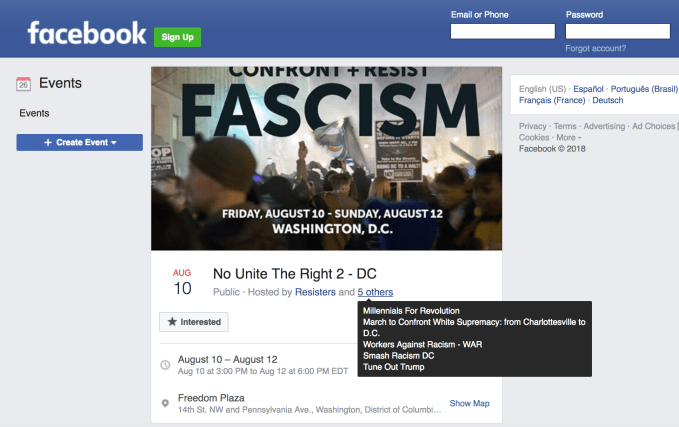
Facebook provided an image of the deleted “No Unite The Right 2 – DC” event as part of its announcement today that merely showed its image, title, date, location, and that a Page called “Resisters” was one of the hosts of the propaganda event. But a scraped event description TechCrunch discovered on Rallyist provides deeper insight into the disruptive information operation. Facebook won’t name the source of the election interference but said the attackers shared a connection through a single account to the Russian Internet Research Agency responsible for 2016 presidential election interference on Facebook.

“We are calling all anti-fascists and people of good conscience to participate in international days of action August 10 through August 12 and a mass mobilization in Washington DC” the description reads. “We occupy ICE offices, confront racism, antisemitism, islamaphobia, xenophobia, and white nationalism. We will be in the streets on August 10-12, and we intend to win.”

But what’s especially alarming is how the event description concludes [emphasis mine]. “Signed, Black Lives Matter Charlottesville, Black Lives Matter D.C., Charlottesville Summer of Resistance Welcoming Committee Agency, Crimethinc Ex-Workers Collective, Crushing Colonialism, D.C. Antifascist Collective, Future is Feminists, Holler Network, Hoods4Justice, The International, Capoeira Angola Foundation-DC (FICA-DC), Libertarian Socialist Caucus Of The DSA, March For Racial Justice, Maryland Antifa, One People’s Project, Resist This (Former DisruptJ20), Rising Tide North America, Smash Racism D.C., Showing Up for Racial Justice Charlottesville, Suffolk County DSA, Workers Against Racism, 350 DC.”

It’s unclear if the attackers effectively ‘forged’ the signature of these groups, or duped them into signing off on supporting the rally. The attackers were potentially trying to blame these groups for the rallies in an effort to further sow discord in the political landscape.

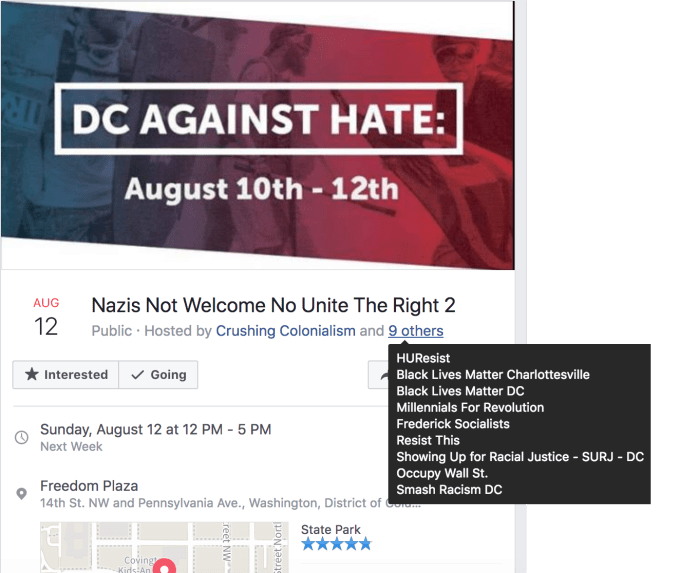
Facebook initially provided no comment about the description of the event, but then confirmed that it was originally created by the attackers’ since-deleted Page ‘Resisters’ which then later added several legitimate organizations as co-hosts: Millenials For Revolution, March To Confront White Supremacy – from Charlottesville to DC, Workers Against Racism – WAR, Smash Racism DC, and Tune Out Trump. Strangely, those co-hosts have relaunched a new event with a similar name “Nazis Not Welcome No Unite The Right 2” and similar description including a similar but expanded “Signed by” list, and now include BLM Charlottesville and D.C. as co-hosts.

Meanwhile, Facebook also shared an image of a November 4th, 2017 “Trump Nightmare Must End – NYC” event, also without details of the description. A scraped version on the site AllEvents shows the description as “History has shown that fascism must be stopped before it becomes too late. There is only one force that can stop this nightmare: we, the people, acting together. On November 4 we’ll take to the streets demanding that Trump regime must go! We meet at Times Square (42 St and Broadway) at 2 PM!”

The co-opting of left-wing messaging and protests is a powerful strategy for the election interferers. It could provide the right-wing with excuses to claim that all left-wing protest against Trump or white supremacy is actually foreign governments or hackers, and that those protests don’t represent the views of real Americans.

source https://techcrunch.com/2018/07/31/false-flag-events/


source https://derekpackard.com/midterm-attackers-cited-black-lives-matter-in-false-flag-facebook-rally/

The U.S. Consumer Product Safety Commission has the most unexpectedly hilarious Twitter

TwitterFacebook

This is Ode To…, a weekly column where we share the stuff we’re really into in hopes that you’ll be really into it, too.

The U.S. Consumer Product Safety Commission is here to warn us about unsafe products and best practices when using certain products. And, it seems, to also keep us entertained with some of the weirdest meme-filled tweets of any government agency. 

Most recently the account has received attention in the past for its unusual approach to education and recently got the attention of unfamiliar users with a single-word tweet. 

Horses.

— US Consumer Product Safety Commission (@USCPSC) July 20, 2018 Read more…

More about Twitter, Memes, Social Media, An Ode To, and Culture

SocialMedia?d=yIl2AUoC8zA SocialMedia?i=iOjVYuAUV6A:bsc4PY-2pBo:gI SocialMedia?i=iOjVYuAUV6A:bsc4PY-2pBo:V_ SocialMedia?d=7Q72WNTAKBA SocialMedia?d=qj6IDK7rITs

source https://mashable.com/2018/07/31/uscpsc-government-agency-weird-twitter-account/


source https://derekpackard.com/the-u-s-consumer-product-safety-commission-has-the-most-unexpectedly-hilarious-twitter/

See the trippy propaganda images attacking the midterms on Facebook

Facebook just confirmed that an unknown group is waging a propaganda war against the US midterm elections. Using images and event invites to rallies in Washington next week, the attackers are attempting to sow discord into the American political landscape. Facebook has not identified whether Russian intelligence organizations were responsible like with their 2016 election attacks, as this operation was more sophisticated than previous strategies Facebook has implemented safeguards to thwart.

For now, Facebook has removed 32 pages and accounts associated with the group, including “Mindful Being,” and “Resisters”, some of which shared psychedelic memes in an attempt to ingratiate themselves with receptive users. Last week I wrote that Facebook had dodged the question of whether it had evidence of attacks on the midterm elections. Now we have the answer: yes.

Scroll down or click through to see a sample of the images used in the attacks. TechCrunch does not endorse any of this imagery.

For more info, read our full-story on these attacks on democracy.

source https://techcrunch.com/gallery/facebook-midterms/


source https://derekpackard.com/see-the-trippy-propaganda-images-attacking-the-midterms-on-facebook/